VINCENT MONNIER
SENIOR / LEAD LEVEL DESIGNER
GAMEPLAY DIRECTOR
Hands-on Game Design & Level Design
Action-Adventure & World Design
Design becomes real when players can move, fight, choose, and feel it on screen.30 years turning AAA action-adventure vision into playable spaces, systems, and player experiences, across Senior, Lead, and Gameplay Director roles.
STAYING CLOSE TO THE PLAYABLE EXPERIENCE
Whether the role is Senior Level Designer, Lead Level Designer, or Gameplay Director, my work is strongest when it stays close to the playable experience.
Gameplay direction taught me to connect vision, systems, disciplines, and production reality without drifting away from the build. The work is not to protect an idea in theory. It is to reduce uncertainty by getting decisions on screen, seeing how they affect the player experience, and helping the team adjust fast enough to matter.That is why I can operate at different levels of responsibility: direct contribution, lead alignment, or gameplay direction. The title changes the scope. The core contribution stays the same: make the experience playable, readable, and strong enough to support the game’s direction.
TRAVERSAL AS IDENTITY
Movement is the first language of a game.
Before a player reads a word or hears a line, they already know what kind of world this is because of how they move through it. Traversal is not a feature layered onto a design. It is the first relationship between the player and the world.Designing the rooftop flow of Jerusalem for Assassin's Creed meant making a player feel like they belonged to that city before they understood why. The geometry had to earn that feeling without explanation — through sightlines, rhythm, the way a ledge invites rather than blocks. Revisiting 3C foundations mid-production on a major AAA title, the question was the same: not "does this work mechanically," but "does moving through this space feel like freedom, or does it feel like compliance." That tension shapes every traversal decision — from layout to pacing.
SPACE THAT TELLS, WITHOUT TELLING
Level design that works gives characters their silence back.
A level designer's real responsibility is to carry meaning through space — so writers can write about people, not directions. Environmental storytelling isn't decoration. It frees dialogue to be about people — not exposition, not the world explaining itself, not directions dressed as conversation.A Muslim funeral procession in Assassin's Creed, designed as a slow playable traversal through a crowd. No dialogue. No cutscene. Just layout, pace, and the weight of moving bodies. Artists on the team who recognized the ritual stopped and said it felt true. That's the signal — not "the player understood it," but "the player felt it without being told." The hardest skill in environmental design isn't knowing what to put in. It's knowing what to leave out — and trusting that the space will carry it.
Open to Canada & US — remote, hybrid, relocation
CASE STUDIES
Selected gameplay spaces and player experiences I designed or directed.
Each example comes from a different production context — shaped as much by constraints, iteration, and opportunity as by initial direction.
Shadow of the Tomb Raider — Co-op
Gameplay Director, Eidos Montréal — 2016-2018
The core challenge: design tombs that work as a complete solo experience and become something different — not just bigger — when played with another person. The solution wasn't combat or shared survival. It was time, space, and chosen roles: two players splitting paths, solving steps in parallel, accessing areas that only open through cooperation. A co-op experience built on the DNA of Tomb Raider — exploration, puzzle-solving, and the satisfaction of being smart together.

Rise of the Tomb Raider — The Orrery
Lead Level Designer, Eidos Montréal — 2014–2016
Designed as an optional challenge tomb, The Orrery was promoted to the main campaign path after winning over the Crystal Dynamics lead team — and became a reference point for the tomb design approach that followed. The central mechanic: an environment that activates and transforms. When the mechanism starts, new traversal paths open, new puzzle logic emerges. Space doesn't just contain the challenge — it becomes the challenge when set in motion. This is the tomb that defined the puzzle-driven standard reused across Shadow of the Tomb Raider.

Prince of Persia Redemption — Internal Tech Demo
Lead Level Designer, Ubisoft Montréal — 2010
The concept: what happens when the environment itself moves? Not a fixed map with mobile elements, but a living creature as the level — shifting, breathing, forcing the player to read space differently at every moment. My role was to deliver this demo on time and at the right quality threshold, resolving blockers across a multidisciplinary team. The demo was presented to editorial as proof of capability — not as a game pitch, but as a demonstration of what the team could build. It worked. The team moved forward into a new project, and I was offered my first director role.

Open to Canada & US — remote, hybrid, relocation
TIMELINE
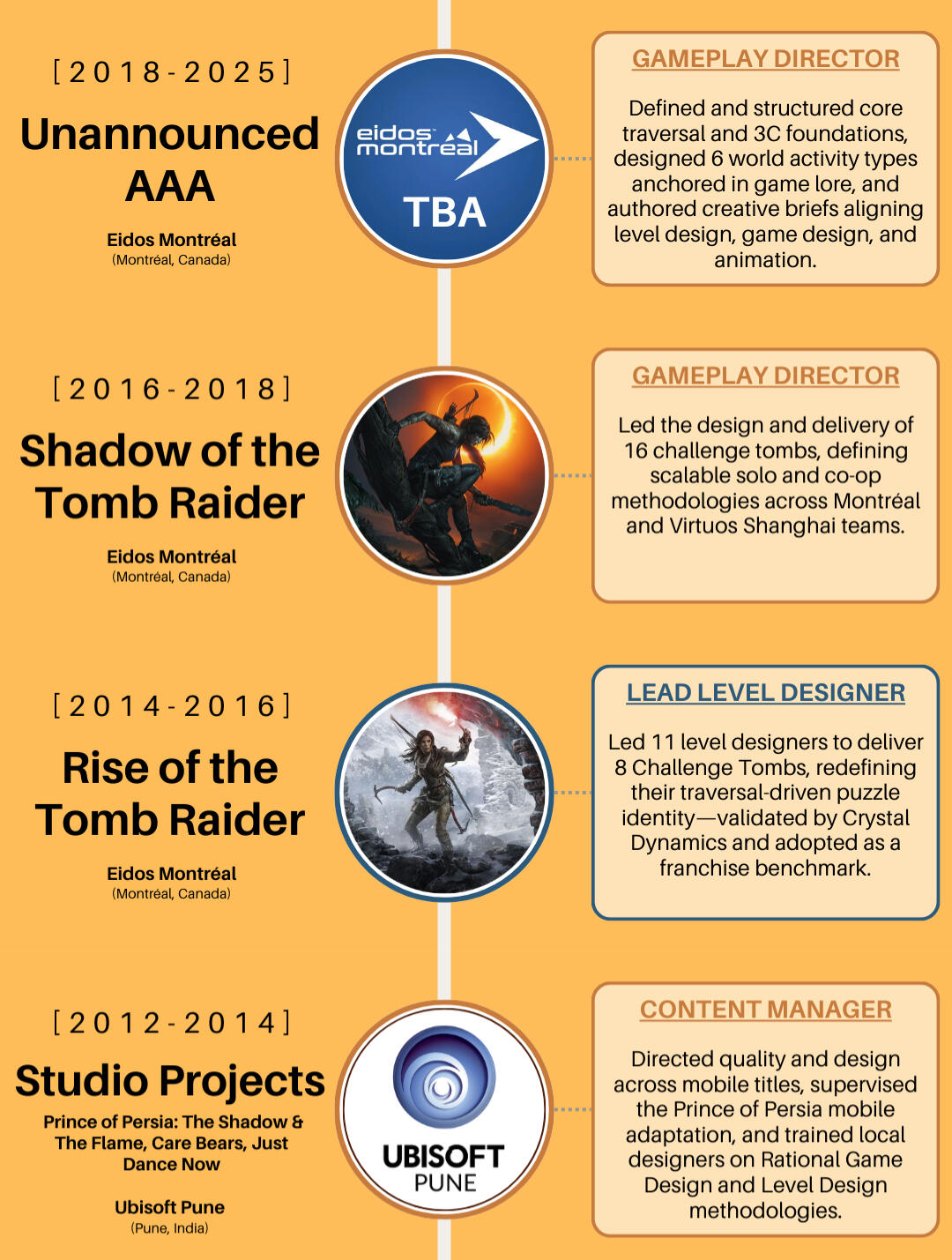
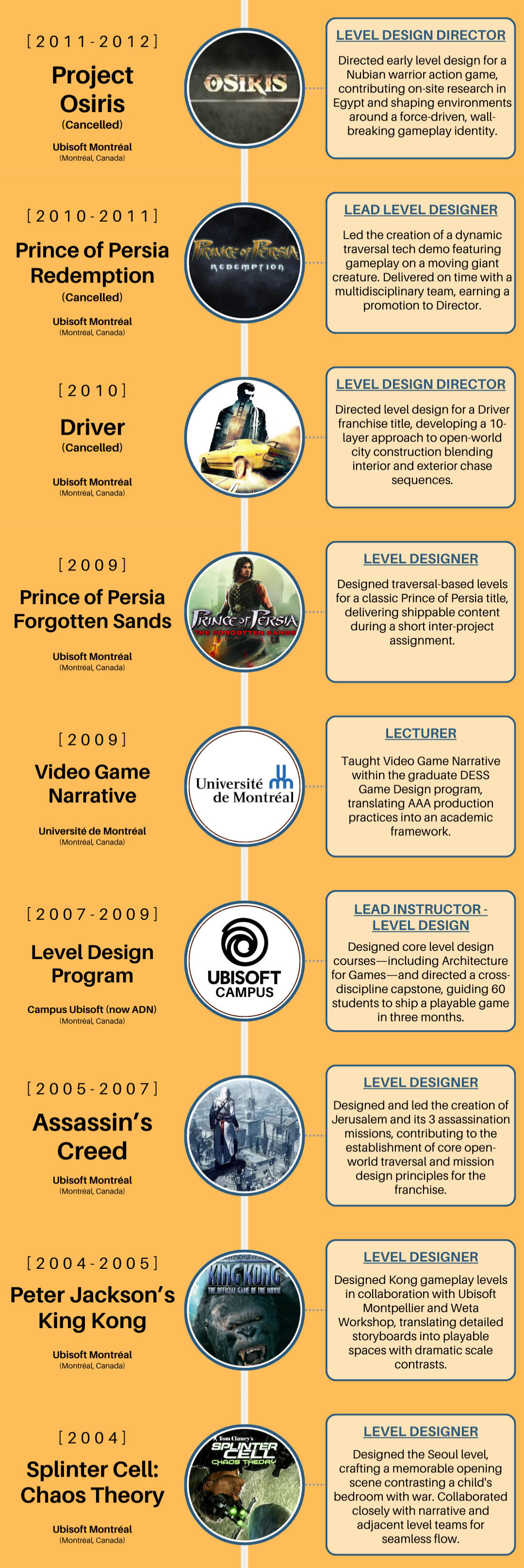
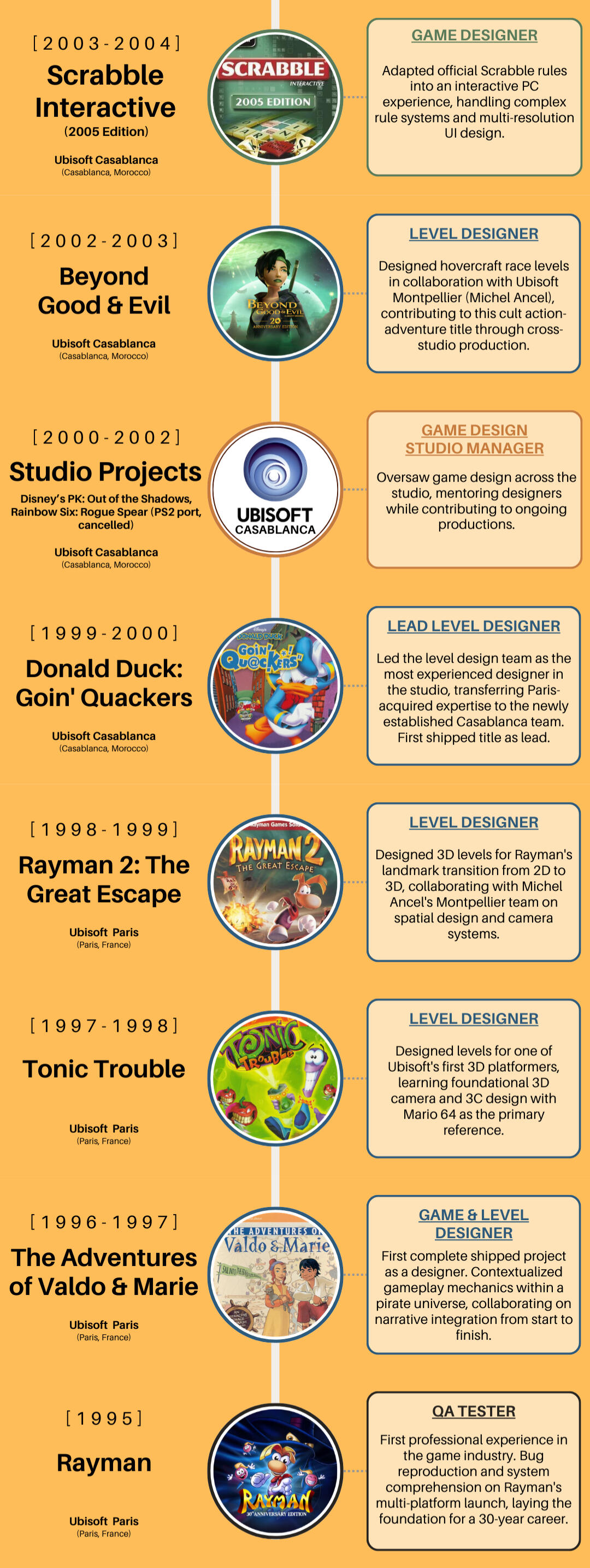
This timeline brings together projects, roles, and responsibilities that don’t fit neatly into a one-page resume.
Some paths moved forward, others changed direction — but together they trace a continuous journey through space, gameplay, and collaboration.
2012-2025: SENIOR LEADERSHIP & GAMEPLAY DIRECTION
2005-2011: AAA EXPANSION & DIRECTION
1995-2004: FOUNDATIONS & CRAFT
Open to Canada & US — remote, hybrid, relocation
PROTOTYPE

Open to Canada & US — remote, hybrid, relocation